

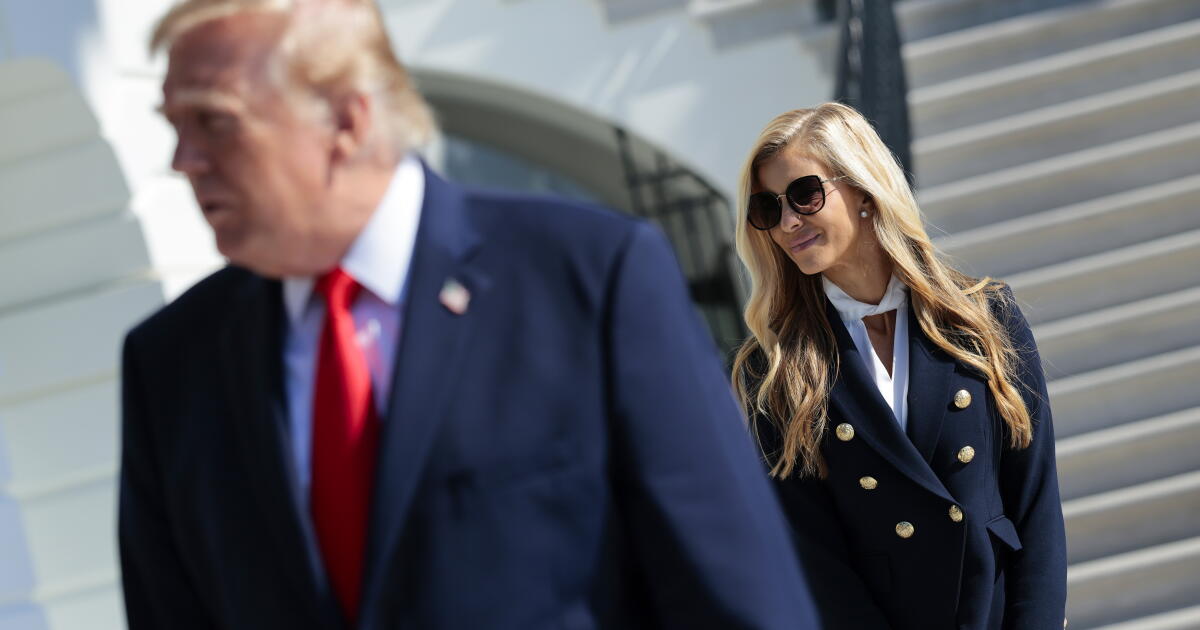
The State Bar of California has opened an investigation into Katie Zacharia, who faced scrutiny during her brief stint as White House press secretary for calling herself a lawyer despite never passing a bar exam.
The probe, which was made public on Thursday, comes in response to a complaint submitted last month by the nonprofit watchdog Campaign for Accountability alleging that Zacharia may have violated California law by touting herself as lawyer.
While Zacharia, a Huntington Beach native, received a law degree from Pepperdine University in 2011, she did not pass the bar exam in California or any other state. Yet, since at least early 2025 she has described herself as a lawyer on national television and in podcasts, including on “The Greg Kelly Show” and CNN, and has been identified on screen as a lawyer in at least 18 appearances on Fox News, according to the complaint.
You might have to read closer into the statute, though. I doubt anyone cares if she calls herself a lawyer on TV. After all, she does have a law degree, she’s more of a lawyer than I am. They’re going to care if she has engaged in any activity that requires a lawyer licensed to practice in California, though.
I think that is actually her point. She has an actual law degree, she’s just not licensed to use it anywhere. If all she has ever done is talk about stuff and was careful enough to make the licenced lawyers sign anything important, then she’s probably in the clear.
Having a law degree does not make you a lawyer.
Having a medical degree does not make you a physician.
Having an accounting degree does not make you a CPA.
Having an engineering degree does not make you a Professional Engineer.
Having an architecture degree does not make you an Architect.
etc.
These things all require specific licensure.
Well, no, you’re not quite getting it. There’s a difference between having a degree and being recognized by accreditation boards to do official work.
There are lots of engineers who have engineering degrees, have the word “Engineer” in their job description, and go their entire careers doing Engineering work in their discipline. What those folks cannot do (and a PE can do) is put their signature on official documents that are then used by local governments for planning and building purposes. But that covers a quite a narrow bit of the broader set of Engineering disciplines.
Similarly, Lawyers who graduate from law school need to pass the state bar exam to be recognized to practice in that state. A lawyer who passed the bar in New Mexico is still a lawyer when they drive to Arizona, the only difference is they can’t represent anyone there or file official documents there unless they also pass the bar in Arizona.
If a lawyer gets a law degree but cannot pass the bar in any state, well, that’s embarrassing for the lawyer. But they’re still a lawyer, they just can’t do any of the official lawyer things.
It’s actually similar for doctors, too. They can go to medical school and get their MD, but then they have to go through all sorts of other accreditations to be recognized as someone who can prescribe medicine and treat patients. There are MDs who also do research, and also get PhD’s. They generally don’t have to get accredited to treat patients, because they do medical research instead (with their own accreditations). But they’re still Medical Doctors. (And much smarter than me.)
All of this has already been litigated extensively.
This is not a rhetorical question but a very specific legal question. Legally, to call yourself an attorney is to imply that you are entitled and qualified to practice law though she claims that there is a distinction between “lawyer” and “attorney” that makes the difference. These are not just words but actual legal terms. Most people use the words interchangeably, as do I. But in Katie Zacharia’s case it probably doesn’t even matter, as it will be her actions over the span of fifteen years that will be examined.
First, there are time-worn and accepted ways of presenting yourself if you have a law degree but are not yet admitted to a bar. It’s a problem that every post-J.D. and pre-bar-admission future lawyer has until the day they get their passing bar results. You can qualify your standing with a J.D. after your name. You can also call yourself a “legal analyst” or “law clerk” or “post-degree fellow” or really any title other than “lawyer” or “attorney.” If you go to work for a firm and it comes up, they clarify your “supervised” status as necessary, if it comes up.
You can also, if it’s going to be your actual ongoing profession and you want to be called a lawyer, just pass the bar somewhere. California is where she tried, but there are other states where the bar exam isn’t quite as grueling. She didn’t do any of that, as far as I know, yet she got her law degree in 2011.
In a profession that literally exists in words and where fortunes have been lost on ill-placed commas, words don’t just matter. They are everything. And it’s not just that she called herself a lawyer, which she apparently did regularly. She also allowed people with whom she interacted professionally – including the American public as a whole – to BELIEVE that she is a fully qualified attorney and rarely (if ever?) corrected that perception. Even Trump called her “an attorney.” It was only when she became White House press secretary that reporters started looking, and when confronted she did not qualify the perception immediately.
Unfortunately, California Business and Professions Code Sections 6125 and 6126 prohibit the unauthorized practice of law (also known as UPL) and representing oneself as entitled to practice law without the required authorization.
6126(a) is likely going to be the most problematic for Ms. Zacharia:
Check out that last line: if a second or later offense gets no actual jail time it’s written into the law that the judge has to note the specific reason for their leniency on the record.
And all of this for what is technically a misdemeanor in California. In other states it’s a full felony, or escalates to one on subsequent offenses. So wherever you go in the US, calling yourself a lawyer without having a license is not a semantic issue, but an act with legal ramifications that is taken seriously by the lawyers who not only comprise the bar associations but likely wrote the laws themselves.
In her case, a watchgroup filed a complaint with the California Bar Association, and they have to investigate now: no blind eye left to turn here. According to that group,
Oooof. That sure doesn’t look like semantic confusion anymore. She has also bizarrely claimed that back in the day a Pepperdine University adviser told her she could call herself a lawyer, but so far Pepperdine has avoided confirming or denying, though they did issue a statement.
So depending on the actual evidence and their own politics it’s possible that the California Bar Association could rule in her favor anyway, but there’s a fair chance they will not. And if they do not, Katie Zacharia may find herself unable to get a law license in ANY state, because every state’s bar has some form of “character and fitness” requirement, and there is also the California Bar’s Rules of Professional Conduct, which has an entire chapter devoted to maintaining the integrity of the legal profession.
Again, she has a J.D. and got as far as taking the bar exam in California. She knows all of this, and has all along.
So when she described herself as a lawyer not just in word but in description (“general counsel”) and repeatedly failed to correct the record when others addressed her in that capacity despite all the ways in which she obviously knew this was not acceptable – if that’s what the finding shows – she kind of pissed in her own Wheaties when it comes to getting a law license anywhere. To be clear, what she did is not an absolute block to licensure, but when you’ve pissed off an entire country’s legal guild by calling yourself a lawyer when you’re not, it’s safe to say your chances diminish.
TL;DR: To attorneys, the word “lawyer” has very specific legal connotations and anyone with a J.D like Katie Zacharia already knows exactly what they are, why, and what the penalties could be, even if it’s a meaningless distinction to the regular public. And she chose to do it anyway. For fifteen years.
I genuinely think you just supported my point with many extra examples.